Smoothies: quick nutrition in a pinch

You’ve got a big interview at 9 a.m. and the clock just struck 8:30. The site of the interview is 15 minutes away, which means you’ve got about 15 minutes to get breakfast ready and eaten. What do you do? Settle for a cereal bar? Starve yourself?

I’m here to tell you that you don’t have to do either. Make a smoothie instead! All you need is a blender, a liquid, and fresh/frozen fruits and veggies.

The best part about smoothies is that not only do they come together in a flash, but you can take them on the go with you. That means no time is wasted sitting down or doing dishes.

Plus, the variety is endless. Earlier I said that a liquid and fruits and/or veggies are all you need, but you could also boost your smoothie with protein powder, add some healthy fats with seeds or nut butter, and try different kinds of milks.

Whenever I want a complete meal in a smoothie, I like to use a cup of lowfat kefir as my base, ½ a cup of frozen fruit/veg, and ½ a cup of fresh fruit and veg. As an example of how adventurous you can get, I recently made a kefir smoothie with frozen banana, mango, and ginger!

Next time you’re in a pinch for a quick and nutritious meal, don’t settle. Blend up some fruit and veg in a liquid of your choice and get moving!

What kind of smoothies do you guys like to make? Let me know in the comments below! I’m always looking for inspiration. As always, stay healthy—even in a hurry.

Major Time-Saver in the Gym: Having a Plan

If you were driving some place you’ve never been to, which would get you there faster, following a GPS, or trying to figure it out yourself? Unless you’ve got some elite survivalist navigation skills, you probably answered, “the GPS.”

The same holds true for working out. You’re going to achieve your goals and spend a lot less time (though not necessarily effort—you still gotta go hard!) by following a credible workout plan. In this post, we’re going to talk about the necessary components of a comprehensive program so you know what to look for.


Start with a warmup

You can’t just storm in the gym, guns blazing, and start throwing around every dumbbell in sight. I mean you can, but you might hurt yourself. That’s why your workout strategy needs to include a warmup.

Does that mean stretching? Yes and no. Research suggests that static stretching (the kind where you hold a position for several seconds) can actually reduce performance and increase the risk of injury. The kind that most fitness experts recommend is dynamic stretching. These are short movements that have you extending beyond your ordinary range of motion, like kicking your foot to your hand while standing.

A good example of a warmup routine, and one that I’ve been following recently is Joe Defranco’s Limber 11. If you want to see it in action, video is here.


Onto the workout

For the workouts, as for any aspect of a fitness strategy, you have virtually limitless options. What you choose here will depend on your goals. One thing I universally discourage, though, is designing your workouts yourself. Unless you have extensive training in exercise science, I would look for whatever kind of plan you want, whether it be focused on weight loss, muscle gain, flexibility, or increased performance for a sport, and find one from an authoritative source.

Online communities can be a good resource in your search. If you don’t know where to begin, check out r/fitness’s recommended routines list.


Don’t forget the cooldown

So after you warm up and do your workout, you’re finally done…right? Not quite. You want to do some of that static stretching we discussed earlier after your workout in order to increase flexibility and reduce muscle soreness. Just make sure you are stretching the muscles that you worked, i.e., not doing shoulder stretches on leg day.


Make sure you get a good program that doesn’t overlook the three elements discussed in this post—warmup, (obviously) the workout, and cooldown. If you do, you should make great progress, more than you would if you walked around the gym without a plan.


HIIT’s Time-Saving, Fat-Burning, Cost-Cutting Benefits


men s black crew neck shirt

On this blog, we’re all about how to get the biggest health benefits for the least amount of resources, whether that be time, money, or both. The strategy I’d like to talk about for doing that today is HIIT.

What is HIIT?

If you’ve been paying attention to fitness trends for the last few years, or you have friends who do, you’ve probably heard of HIIT. HIIT stands for High Intensity Interval Training. Basically, it consists of short bursts of all-out effort, with windows of recovery in between.

And there’s a reason for its widespread popularity. Actually, there are three: it’s fast, it’s effective, and it’s cheap.


HIIT is fast

It isn’t just you who’ll move fast in a HIIT workout; the workout itself is over before you know it too.

A typical HIIT workout will only last between 10-30 minutes, but according to a study by Chinese sports medicine researchers, it’s about as effective as double that amount of moderate-intensity exercise, which brings me to my next point.


HIIT is effective

When it comes to weight loss, HIIT has unique advantages.

A session of HIIT done properly will create an “afterburn” effect, resulting in a higher metabolic rate for several hours post-exercise, according to several studies, such as this one out of Singapore. This means that with one small time investment of a HIIT session, you’ll reap the calorie-burning benefits for multiple times the amount of time you originally spent. It’s like accruing interest on your exercise!


HIIT is cheap

My favorite aspect of HIIT (though it’s hard to choose among all these awesome perks) is its low cost and versatility.

You can literally do HIIT anywhere and with anything. For example, when I wanted to get a quick workout in, I took to my local bike trail and did 5 sets of 30-second sprints with 90-second jogs in between. It was brutal but felt great and didn’t cost me a dime. So you’re not only investing minimal time, but minimal money into one of the best forms of exercise you can do.


How do I get started with HIIT?

Developing your own HIIT routine is easy. Just take any exercise you enjoy, and rather than performing an extended, moderate effort, break it up into short bouts of maximal effort. In my example in the last paragraph, I did running because it’s simple and I’m a simple guy (plus, I did track and cross country in high school, so doing sprints kind of brought me back). But if you like cycling, for example, you can do the same thing: just bike-sprint for a short amount of time, rest up enough to recover, and repeat. Do that, and you’ll be feeling the powerful, efficient benefits of HIIT in no time!

Have you tried HIIT before? If so, what are your favorite exercises? Lemme know in the comments below, and as always, stay healthy!

Photo by Gabriele Ribeiro on Pexels.com

If I Interviewed Scooby Werkstatt of Scooby’s Workshop

scoob

Bio

Scooby Werkstatt is the creator of scoobysworkshop.com, a resource for bodybuilding, nutrition, and fitness advice. While he doesn’t boast any credentials in nutrition or personal training, he has 30 years of mostly injury-free weightlifting under his belt. Most of the advice on his website is heavily researched, with the citations to back it up. He embodies the theme of this blog, which is fitness progress without financial regress, through his advocacy of home workouts and dedication to saving his audience every penny.

Why interview Scooby? Who would be interested?

I’d like to interview Scooby to find out his motivation behind beginning his website. He creates multiple types of content—workout programs, meal plans, videos, and articles—so I’d also be interested in asking him about his creative process behind his content. People who are curious about starting their own online fitness enterprise might be interested in reading about Scooby’s inspiration and process.

Five questions I would ask him

What triggered your starting Scooby’s Workshop?

Why is fitness important to you?

What are the biggest challenges you’ve faced in maintaining your website?

What advice do you have for anyone aspiring to develop a fitness web presence?

How long do you plan to continue running Scooby’s Workshop?


The Fitbit Flex 2

Dramatic Narrative

Heart pumping. Sweat dripping. Feet falling. The city lights cast various glows on me—deep red, vibrant yellow, dull white—as I dash down the sidewalk. I feel a vibration on my right wrist, and, looking down at it, see another kind light show. The five LEDs on my Fitbit Flex 2 shine and dance in an array of colors, celebrating that I achieved my step count for the day. At the end of my run, I pull out my phone, end my run in the Fitbit app, and pore over the day’s fitness data. My hours slept, calories in/out, water consumed, active minutes, and step count are all there to help me strive toward a better me.

Summary Narrative

The Fitbit Flex 2 is a simplistic wearable tech option for fitness enthusiasts. Without a screen, the device is not ideal to use as a regular smart watch. Instead, it has five LED lights that can be configured to track different statistics. The real benefit to owning a Flex 2 (or any Fitbit product, really) is having access to the Fibit app. Through the app, you can view all of the fitness data that your Fitbit gathers such as hours slept, water consumed, active minutes, step count, and more.

Craigslist Misadventures and Nutritional Enlightenment

Section 1: First-person negative experience

A few weeks ago, I made the decision to try working out at home rather than at the gym, and to do that, I needed a little equipment. I already had a pair of adjustable dumbbells with four 5 lb plates, but that was getting too light, so I started the hunt for more weights.

First, I checked a local fitness store, and a staff member told me their weight plates were priced at a DOLLAR A POUND. No WAY was I going to pay 40 bucks for a stack of metal. So I took to Craigslist.

Craigslist came up with a few listings, and one looked particularly promising. This guy was selling his weights at 70 cents a pound—not super cheap, I thought, but still seems like a deal. While I was on Craigslist, I thought I’d look for a bodyweight scale too, to keep track of my progress. I found another listing for a wi-fi enabled smartscale that pairs with your phone and gives you all kinds of cool body metrics…for only 15 bucks! Seemed good to me, so I set out to pick up the weights and the scale.

The guy selling the weights was insistent that I meet him at his place before dark, which is about 5:45 PM around here right now, and I got off work at 5. He also had never heard of Venmo, so I needed to get cash. He lives about a 15-minute drive from my place in regular traffic, but I needed to walk the mile home from work, go to my bank to withdraw cash, and then head over to his place—during rush hour—careful not to make it past dark. I managed to make it on the brink of nighttime, got the weights and headed off to get the scale.

I drove for about 20 minutes, going past my house in the opposite direction, to arrive at a vape shop in a strip mall. The guy behind the counter gave me the scale, and I finally returned home.

Opening the scale’s box, I noticed the cover for the battery compartment was missing. I was able to turn it on and weigh myself, but I couldn’t get it to pair with my phone. I thought, Meh, I guess I can just use it like a regular scale. Two days later, I tried to weigh myself again, and it wouldn’t even turn on. Fifteen bucks down the drain.

At least I got a good deal on the weights. Or so I thought. After doing a little research online, I found advice from a home fitness expert that said, “Always buy your weights used,” Ok, check. “…for no more than 20 cents a pound.” Maybe it wasn’t as good of a deal as I thought.

Moral of the story: research the market price for whatever you’re buying on Craigslist, and try to avoid electronics. Especially if they seem too cheap to be true.


Section 2: Third-person positive experience

Understanding the basic nutritional composition of food can be an eye-opening experience. A lot of people emphasize eating whole, unprocessed foods. And while they’re right to do so, there is a tendency to make it sound like someone could eat as much of whatever kind of food they want as long as it is pulled straight from the earth.

But that doesn’t work. Avocados, for example, are an unprocessed food, and given the proper place in someone’s diet, quite healthy. Eating nothing but avocados, however, will guarantee weight gain as well as a host of other potential problems. That’s because avocados are primarily composed of fat, only one of the three major macronutrients from which energy is derived, the others being carbohydrates and protein.

So while eating avocados alone is ill-advised, eating them alongside lean protein like poultry or fish and a complex carbohydrate like rice or starchy vegetables can make for a pretty balanced meal. Gaining awareness of the nutritional makeup of foods can help someone better balance their meals, granting them a healthier, happier life.


My Time-Saving Home Workout Setup

Sometimes the best gym is your own home.
People lose a lot of time commuting back and forth from a commercial gym, undressing and dressing in the locker room, and waiting to use equipment.
Plus, those monthly membership fees add up.
In this post, I’m going to describe my very humble home workout setup so that you can see how easy it is to get one going at your place.
I don’t have the biggest of rooms. But because I share a house with several other people, I can’t have a dedicated space to workout anywhere else in the house. So I have to make do.
In my roughly 15×8 ft. bedroom, much of the space is taken up by my twin bed along the wall with my door, my TV on the opposite wall, and my desk and printer on the third wall.
In the center of the room, however, there’s a walkway that perfectly fits a red yoga mat. When I want to exercise, I begin by laying that down.
To make extra horizontal space, if I need to spread out my arms, I move my desk chair into my closet. That way, one of my arms can lay in the space between my TV and my desk, and the other can stretch toward the door in the space between my bed and my printer stand.
I’ve also got a pair of dumbbells that I usually keep in front of my TV. I find that having them in constant sight helps to motivate me to exercise.
Pro tip: if you want to work out from home and have space concerns, get a pair of dumbbells. Because they’re two smaller units (unlike a dumbbell, which would be one large unit), you can manipulate them to fit in cramped spaces much easier.
Now that you see how I can make a home workout space in my closet of a room, nothing should stop you from doing it in yours! If something does get in the way, though, feel free to comment and let’s try to figure it out together. For those of you who have home workout setups of your own, I’d love to hear about that too! So drop that in the comments as well if you’d like.
Thanks for reading, and stay healthy!

Extended Gym Hours has Students Divided

At the beginning of the spring 2019 semester, the San Jose State University campus gym extended its hours to midnight on Fridays.

Sport Club outside
The SJSU gym, otherwise known as the “Sport Club.”

Formerly open until 6:00 P.M. on the final day of the work week, the gym will now allow students, faculty, and community members to use its facility a full 6 hours longer. This change accompanies the hiring of several new employees, likely in part to staff the gym for the extended hours.

Student gym-goers think it’s great that they’ll have more time to hit the gym every Friday. “I get out of class at 5:45 on Fridays, so I always had to skip hitting the gym that day. Friday’s leg day, so I’m stoked to finally be able to give my hammies some love” said super-senior Chad Williams, a communications major.

Others, however, are not so happy about the change.

“Friday nights are supposed to be for relaxing and having fun. Now that we’re open until midnight, one of us has to work that shift. No one wants to do it, so usually we settle it by seeing who can bench the heaviest while reciting the national anthem. I’m not really strong or patriotic, which means I usually end up having to work it” said junior Carlos Rivera, a sociology student.

This is the first time in at least two years that the gym has changed its hours. Only time will tell if this change will remain or if push back from staff will reverse it.


How Nutrition Tracking can Streamline your Schedule

You may have heard of calorie counting before and thought, “food takes long enough to buy and cook, who has time to record what’s in it too?”

That’s a reasonable observation, and one I’ve made too.

But what if I told you that keeping track of not only the calories, but more importantly, the nutrients in the food you eat, can actually save you time?

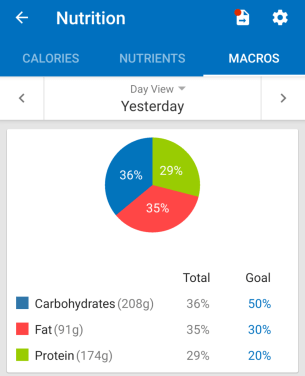
Many smartphone apps now allow us to keep detailed diet logs. I’ve been using MyFitnessPal on my Android, but it’s on iOS as well. This app boasts a database of 5,000,000 food items, can scan anything with a barcode for easy entry, and gives helpful visuals of your food’s nutritional breakdown.

Screenshot_20190206-071633.png
One of the helpful charts MyFitnessPal creates out of your data

Today, we’re going to look at the time-saving benefits to using nutrition-tracking apps like MyFitnessPal.

Planning ahead

My favorite way to use nutrition tracking actually isn’t so much logging my food after I eat it, but before. You can use your downtime the night before a big day to plan your meals, avoiding the hassle when things get hectic. When I’m busy running to and from school and work, the last thing I want to do is get slowed down trying to think of how I can squeeze in a nutritious meal. Or worse yet, settle for something quick and unhealthy.

More energy

Worse because eating unhealthy can worsen your mood and slow down productivity. So you may have saved some time eating that quick snack, but you may lose some later, when you’re feeling down or unable to focus. Planning and analyzing what you eat can ensure you’re getting what you need to perform your best.

Better intuition

Nutrition tracking will also show you what you need to feel your best. It’ll shed light on your ratio of “macronutrients”—carbs, fats, and protein—which you can play around with to see what works best for you. For example, I used to eat a much higher carb diet and found myself needing to pack tons of food for long school days. Once I noticed this through nutrition tracking, I upped my protein consumption, which fills the body up quicker and breaks down slower than carbs. Now I don’t have to eat so frequently. Similarly, you can find what kind of food works best for you, and that makes deciding what to eat that much easier. And who knows, you might spend less time packing and lugging around food too!

If you haven’t tried nutrition tracking, I highly recommend you do for the reasons above and more. Feel free to use the app I’ve been using, MyFitnessPal, or check out this list of other apps you could use. If you do use other apps, or if for some reason you don’t want to track your food, go ahead and share your thought in the comment below!

Thanks for reading, and stay healthy!

3 Healthy, Cheap Foods You Need in Your Kitchen

Hi! In this kick-off post to my blog dedicated to healthy living on a tight budget and a cramped schedule, I’m going to cover 3 cheap, healthy, and convenient foods that you should always have on hand.

Oats

Whether you like them rolled, steel-cut, or instant, oats are incredibly cost-effective and good for you.

As far as price goes, oats are about as cheap as it gets. In most stores, oats will range from $1 to $1.50 a pound. I get mine from Costco at a little less than $1 a pound.

Oats are packed with nutrients, the most prominent being manganese, a nutrient necessary to process cholesterol, carbohydrates, and protein. Oats also have high levels of antioxidants and healthy wonder-fiber called beta-glucan, which helps with weight loss, controlling blood sugar, and reducing cholesterol levels.

Frozen produce

While little compares to the taste of fresh veggies and fruit, it’s always good to have their frozen counterparts around. They’re a lifesaver when you don’t have the money to buy fresh or the time to prepare ingredients.

Two pounds of frozen veggies go for $2.22 at Walmart, while 2 pounds of frozen berries are $8.47 from the same. Again, I go to Costco for big bags that are both under $10 each.

As for nutritional value, some studies indicate that frozen produce may even surpass fresh since fresh fruits and veggies begin losing nutrients immediately after they’re harvested, whereas freezing stops that process.

Peanut butter

Our last low-price, high-nutrition friend is peanut butter. Whether you want to thicken up a smoothie, slather it on fruit, or make a Thai sauce, this mashed legume’s got you covered (if you’re not allergic, that is).

A whopping FORTY ounces of peanut butter is only $4.37 from Wal-Mart. I, however, get mine from Costco (are you seeing a pattern here?), which prices it at $11.99 for 56 ounces.

Peanut butter is a great plant-based protein source, low-carb, and high in healthy fats. It should be consumed in moderation, however, since it is potentially carcinogenic.

Do you have any foods that are easy on your wallet and good for your body? If so, please share in the comments below. Thanks and see you next time!